
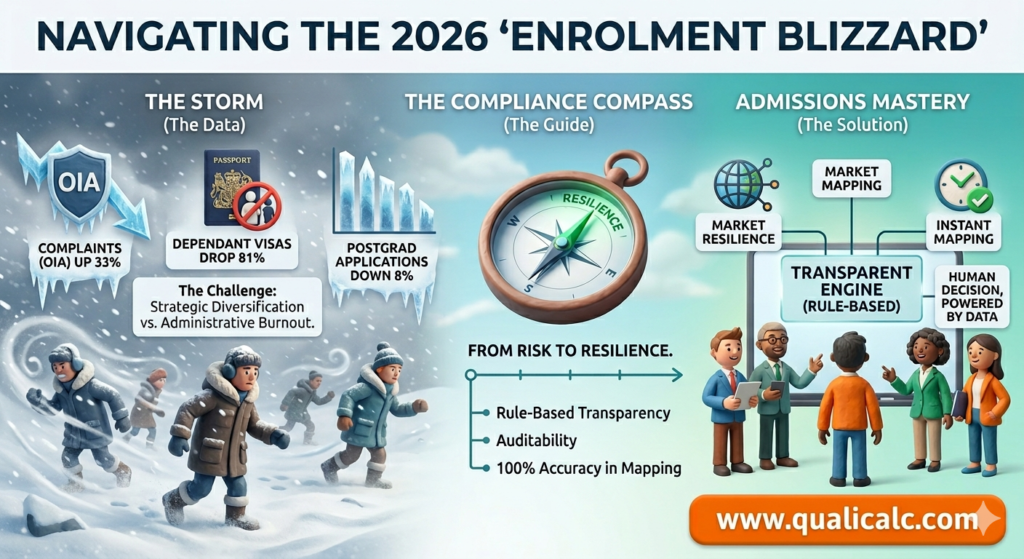
While the UK, USA, Australia and Canada face an “Enrolment Blizzard” driven by tighter visa rules, global demand hasn’t disappeared. It has diversified.
In the UK alone, postgraduate enrolments are down 31% year‑on‑year (BUILA, Apr 2026), with some markets like Pakistan falling by 75%. At the same time, emerging markets such as Nepal are seeing 92% growth.
The real challenge isn’t recruitment — it’s risk
The challenge for universities isn’t just recruitment — it’s risk.
With the Home Office’s new 4% visa‑refusal threshold for maintaining “Green” compliance status, many institutions have narrowed their recruitment pipelines simply to stay safe. But narrowing markets threatens long‑term resilience.
This is why 2026 is the year of strategic diversification.
A new operational reality for admissions teams
37% of UK universities now list diversification into new markets as a top priority. But diversification brings a new operational reality: admissions teams must evaluate a wider range of unfamiliar international qualifications — accurately, consistently, and without slowing down turnaround times.
The 2026 imperative: admissions resilience
To grow sustainably, universities need systems that enable them to:
- Evaluate emerging‑market qualifications with accuracy and transparency
- Strengthen credibility checks without creating bottlenecks
- Balance diversification with compliance under the new traffic‑light system
- Shift from “processing” to partnership in the applicant experience
From a numbers game to a resilience game
Growth in 2026 is no longer a numbers game — it’s a resilience game.
Institutions that diversify safely, supported by rule‑based, transparent admissions technology, will be the ones that emerge stronger from the Enrolment Blizzard.