
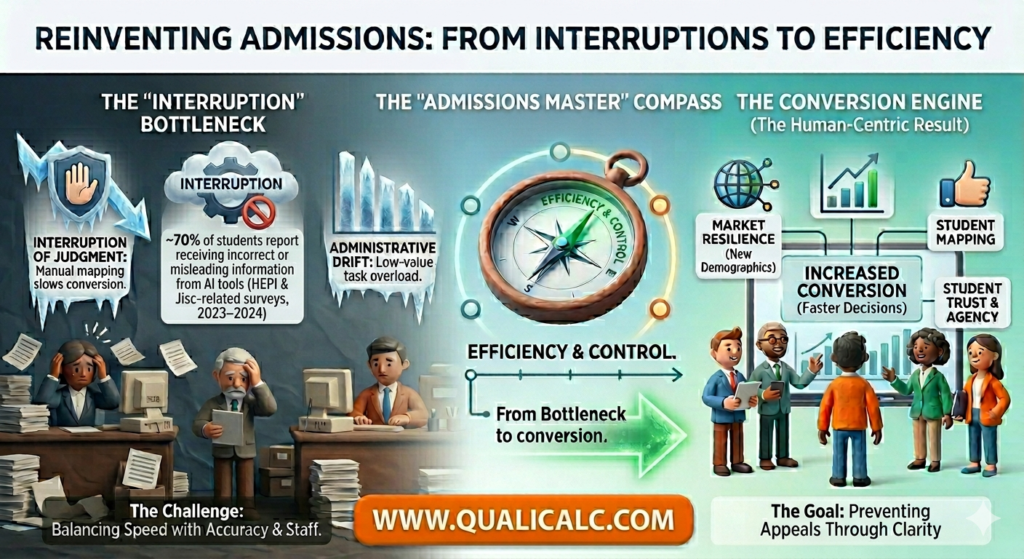
Higher education doesn’t have an efficiency problem — it has a transparency problem.
Across recent UCAS and sector events, one theme keeps emerging: Admissions Without Interruptions. Not faster decisions. Not heavier automation. But systems that remove friction without removing judgment. And that distinction matters.
Recent surveys — including 2023–2024 findings from HEPI and Jisc‑related studies — show that around 70% of students have received incorrect or misleading information from AI tools. Trust in “Black Box” automation is falling fast.
At the same time, manual processes continue to slow down conversion, especially when officers must pause to map unfamiliar qualifications or second‑guess opaque system outputs.
The real bottleneck: interruptions to human judgment
The industry is reaching a tipping point between two models:
- Black Box automation that replaces judgment
- Human‑centric automation that empowers it
The future belongs to the latter.
Why rule‑based engines are the 2026 breakthrough
The most forward‑thinking institutions aren’t chasing “efficiency for efficiency’s sake.” They’re building transparent, rule‑driven systems that:
- Automate qualification mapping instantly and accurately
- Apply institution‑defined course rules with full consistency
- Free admissions officers to focus on high‑trust student interactions
- Maintain institutional agency rather than outsourcing decisions to opaque models
This is the shift from “efficiency” to Operational Excellence — a theme gaining momentum across UCAS and wider HE discussions heading into 2026.
The strategic insight
Automation should never replace academic judgment. It should remove the drudge work that interrupts it.
When rule‑based engines handle the complexity — mapping, matching, verifying — admissions teams can spend their time where it matters: interviewing, advising, and building relationships that drive conversion.
The call to action
Stop solving for speed. Start solving for trust.
The institutions that win in 2026 will be those that choose transparency over complexity and build admissions systems that show their work.