
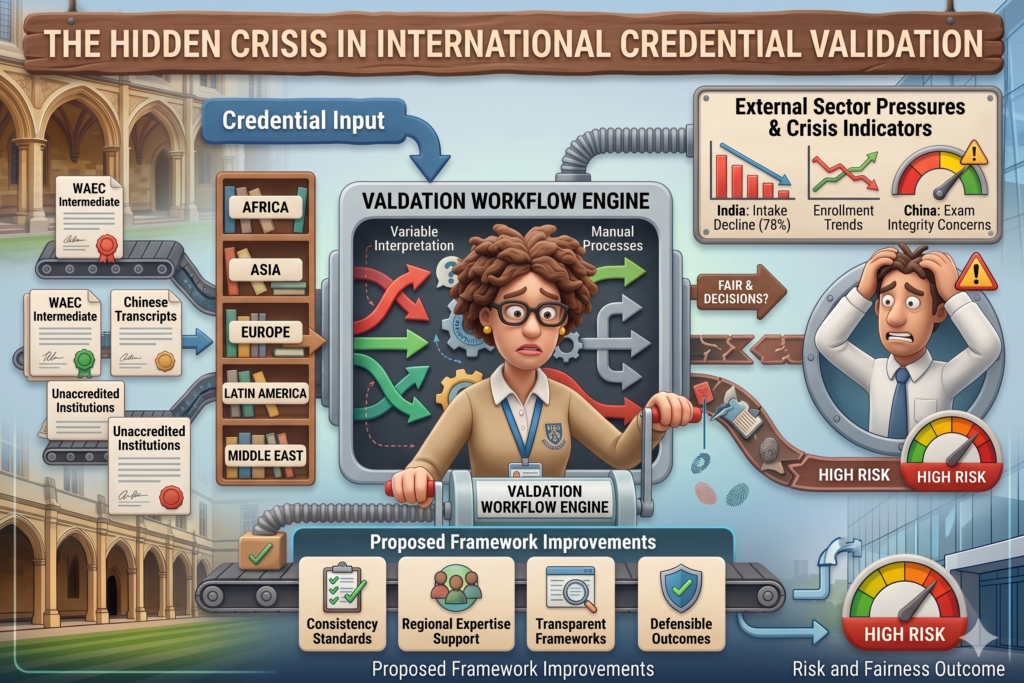
Finance has regulators. Healthcare has licensing boards. International credential evaluation has neither. There is no global authority that governs how a foreign transcript gets read, converted, or trusted — which means two evaluators can look at the same certificate and reach two different conclusions. Both defensible. Both final. Neither reconcilable.
That gap sits underneath almost every pressure international admissions teams are feeling right now — and it rarely gets named directly, because it’s easier to talk about workload than to talk about the missing standard underneath it.
A fragmented system with no referee
Every country, and often every institution within it, has its own grading conventions, its own grade boundaries, its own sense of what “distinction” or “first class” actually means. Without a shared reference point, evaluation becomes a matter of individual judgement — applied inconsistently, under time pressure, at scale.
That inconsistency isn’t a rounding error. It’s a fairness problem, an audit problem, and — increasingly — a compliance problem.
The hidden cost of “just checking”
The administrative burden this creates is easy to underestimate until you total it up. An institution processing 5,000 international applications a cycle can spend upwards of 400 staff hours on verification-related tasks tied to those applications — costing an estimated $20,000–$40,000 a year in staff time alone.
Most of those hours aren’t spent catching fraud. They’re spent on arithmetic: converting one country’s grading scale into another, re-checking a boundary case, re-deriving a decision someone already made for a similar applicant last month. That’s the part of the job that shouldn’t need a human every single time.
Fraud is evolving faster than the paperwork
While staff time gets absorbed by conversion work, the fraud landscape has moved on. It’s no longer just forged certificates — it’s ghost institutions, diploma mills, and quietly manipulated documents that pass a first glance. One widely cited study estimated that up to 50% of high school transcripts submitted in certain application pools had been falsified in some way.
That’s the risk that actually deserves the 400 hours. Instead, much of that time is spent re-deriving grade equivalencies that a consistent, rules-based system could resolve in seconds — leaving less attention for the documents that genuinely warrant scrutiny.
Compliance pressure raises the stakes further
For UK universities, this isn’t an abstract efficiency question. Visa sponsorship now hinges on tight, concurrent thresholds — refusal rates held under 4–5%, enrolment held at or above 95% — and recent policy tightening has already been followed by a 31% average drop in international enrolments for the January 2026 intake.
In that environment, every borderline credential decision carries downstream weight. A conversion error isn’t just an isolated mistake — it’s a data point that can move an institution’s risk rating.
Interpretation isn’t validation
The distinction that gets lost in most of these conversations is this: interpreting a grade (what does this score convert to, how does it map to our entry criteria) and validating a document (is this real, is this institution legitimate, has this been tampered with) are two entirely different tasks. Most institutions still ask the same overstretched staff to do both, using the same unsecured email attachments and manual data entry they’ve relied on for years.
Treating interpretation as if it were validation is how the 400 hours gets spent on the wrong problem.
Where digital credentialing helps — and where it doesn’t
Blockchain-based credentials and national digital depositories are frequently proposed as the long-term fix — and where they’ve been adopted, they’ve cut verification time from weeks to seconds and reduced registrar workload by as much as 90%. But global adoption is slow, uneven, and entirely dependent on the issuing country’s infrastructure. For the vast majority of applications arriving today, the transcript is still a PDF, not a verifiable digital record.
Which means the fix that’s actually available right now has to work with the documents institutions already receive — not the ones we wish they’d receive.
The real fix: separate the arithmetic from the judgement
The most immediate, deployable change is a structural one: pull the conversion work — the grade-to-grade, scale-to-scale arithmetic — out of manual, case-by-case judgement and into a rules-based scoring engine. Applied consistently, it turns a subjective, time-consuming step into an auditable, repeatable one.
That doesn’t eliminate the need for human judgement — it relocates it. Staff stop re-deriving the same equivalency decision hundreds of times a cycle, and start spending that reclaimed time on what actually needs a trained eye: is this document authentic, does this institution exist, does this case deserve a closer look.
The crisis in credential validation isn’t that the work is hard. It’s that the wrong part of the work is absorbing all the time.