
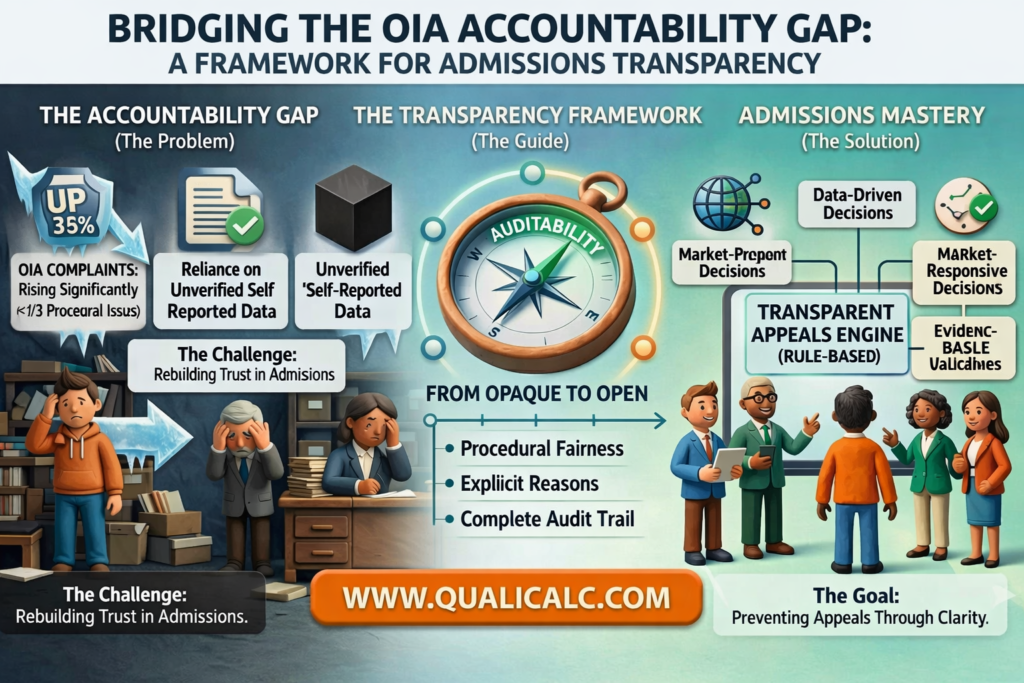
The rise in admissions appeals isn’t a legal issue — it’s a transparency issue.
Sector trends heading into 2026 make one thing clear: a significant proportion of upheld appeals aren’t about disagreement with the decision itself, but about maladministration — unclear reasoning, missing evidence, or inconsistent processes.
In other words, appeals are exposing an Accountability Gap.
Why this matters now
Complaints to the OIA are now approaching 4,000 cases annually, with around a third linked to service failures or procedural issues.
At the same time, sector surveys show that transparency and higher‑order reasoning are top priorities for UK educators as we move toward 2026.
Yet admissions decisions often remain a “Black Box” — a gap between the rules an institution sets and the explanation an applicant receives.
And in a high‑fee, high‑stakes environment, “the system said no” is no longer defensible.
The real test of an appeals process
An appeal isn’t just a challenge to a decision. It’s a test of an institution’s:
- Data integrity — Was the decision based on the latest regional standards?
- Communication clarity — Did the applicant understand why the decision was made?
- Auditability — Can you surface the exact rule applied at the time of assessment?
When these foundations are weak, appeals rise. When they are strong, appeals fall — because families understand the decision before they ever consider contesting it.
The 2026 framework for admissions mastery
Emerging HE research points to a four‑level transparency model that institutions are beginning to adopt:
- Tool Disclosure — What system supported the decision?
- Purpose Clarity — Was it mapping, drafting, or assessment?
- Human Review — How was the output validated?
- Rule‑Based Audit Trail — Can you show the exact criteria applied?
This shifts the conversation from defending a decision to evidencing a standard.
The strategic insight
The best appeals process is the one that never needs to be used.
Not because applicants stop asking questions, but because institutions start giving answers — clearly, consistently, and transparently — from day one.
Fairness isn’t just a moral imperative. It’s an operational one.