
The sector is talking — and for good reason. The new UKVI traffic‑light system has quickly become one of the most discussed topics in international admissions. Not because it changes the rules, but because it changes the visibility of risk.
For years, universities have worked with visa refusal rates as a key compliance indicator — typically with a 10% tolerance in mind. The shift to a 5% threshold represents a significant tightening, and the traffic‑light system brings that risk into sharper focus. It makes the consequences more visible. And visibility changes behaviour.
Across the sector, teams are already adjusting: tightening processes, reviewing documentation more closely, and spending more time on credibility and risk. Not out of caution — but out of necessity.
The 5% refusal rate: the part nobody can control
One thing that often surprises people outside the sector is this: Universities are judged on UKVI’s decisions, not their own.
You can check every document. You can interview every applicant. You can follow every internal process to the letter.
And still — if UKVI refuses the visa, it counts against you.
That’s the part that feels unfair. And it’s why the traffic‑light system is creating anxiety: the stakes are high, but the control is limited.
The internal pressure this creates
Because universities can’t control UKVI outcomes, they try to control everything before issuing a CAS:
- more documentation checks
- more credibility interviews
- more internal scoring
- more “borderline” cases being held back
- more time spent double‑checking decisions
Not because they want to slow things down — but because they’re trying to protect that now‑much‑tighter refusal threshold.
The real bottleneck: time and consistency
Most teams aren’t struggling with policy. They’re struggling with:
- volume
- complexity
- inconsistent documentation
- unpredictable grade patterns
- institutional memory walking out the door
- and the sheer time it takes to evaluate international qualifications properly
The traffic‑light system doesn’t change the rules — it just makes the consequences more visible. And visibility increases pressure.
A new layer: three metrics, one outcome
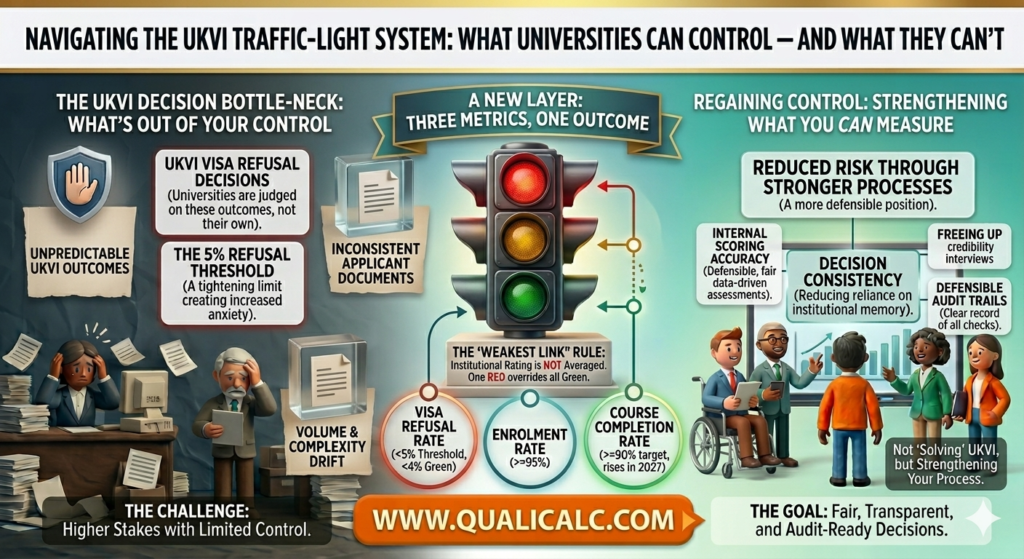
As more details emerge, it’s becoming clear that the new UKVI framework doesn’t just look at visa refusals in isolation. Universities are now being assessed on three concurrent metrics:
- Visa Refusal Rate: Must remain under 5% (with Green requiring under 4%).
- Enrolment Rate: Must stay at or above 95%.
- Course Completion Rate: While the core baseline is 85% (rising to 90% in June 2027), the RAG system flags anything below 90% as Red from day one.
The “Weakest Link” Rule: Ratings are not averaged across the three categories. If an institution performs flawlessly on two metrics but slips into red on just one, the overall institutional rating automatically defaults to Red.
This is a significant shift. It means the pressure isn’t just on CAS issuance or credibility checks — it’s on the entire lifecycle of the student journey. And it reinforces the point that the sector is navigating a period where small inconsistencies can have outsized consequences.
So what can’t universities control?
They can’t control UKVI decisions. They can’t control refusal outcomes. They can’t control the 5% threshold.
But they can control:
- the accuracy of their internal scoring
- the consistency of their decisions
- the defensibility of their CAS issuance
- the clarity of their audit trails
- the time they free up to focus on credibility and risk
This is where tools that support qualification evaluation come in. Not as a UKVI solution — because nothing can “solve” UKVI — but as a way to strengthen the parts of the process that are within a university’s control.
Freeing up time. Improving consistency. Reducing reliance on institutional memory. Supporting fair, transparent decisions. Those things matter more than ever.
A sector on the edge of change
The traffic‑light system isn’t about fear. It’s about visibility.
And in a world where universities are judged on decisions they don’t make, the only real power they have is strengthening the decisions they do make.
That’s where the sector conversation is heading — and it’s fascinating to watch it unfold.